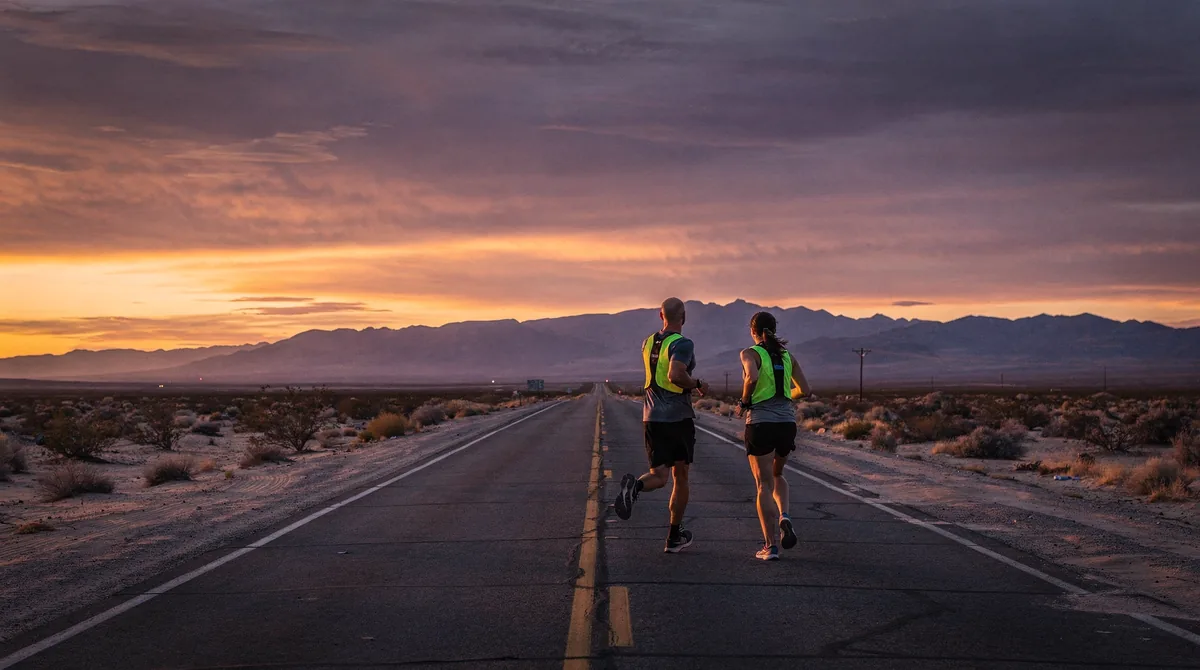
120 miles of Mojave highway from Baker, California to Las Vegas — the largest law enforcement footrace in the world.
The short version: it is the largest law enforcement footrace in the world, and it runs straight through the desert night without stopping.
It started in 1985 with two Los Angeles police officers, Chuck Foote and Larry Moore, and an idea carried over from an older relay through Death Valley. Nineteen teams ran it that first year. About four hundred people stood at the finish.
Word travelled the way it does in this line of work. The next year more than two thousand runners came to the awards ceremony. Four decades on, entries are capped at 300 teams and more than 6,000 runners, and agencies fly in from across the country and from as far away as Calgary, Berlin and Hamburg to run it.
It has never been only for patrol. Deputies, police officers, probation officers, district attorneys, federal attorneys and civilian department staff all run. What holds it together is not the finishing time. It is that everyone on that highway does some version of the same job, and for one weekend a year they get to do something hard together instead of alone.
The race calls it teamwork, camaraderie, fitness and competition. In that order.
There is history out there too. The 1987 race was stopped mid-course by a blizzard in the Mojave, which people still talk about. Larry Moore, one of the two founders, was killed in a motorcycle accident in 2003. The event has kept going, and kept growing, for forty years.
Now it is our turn to run it.
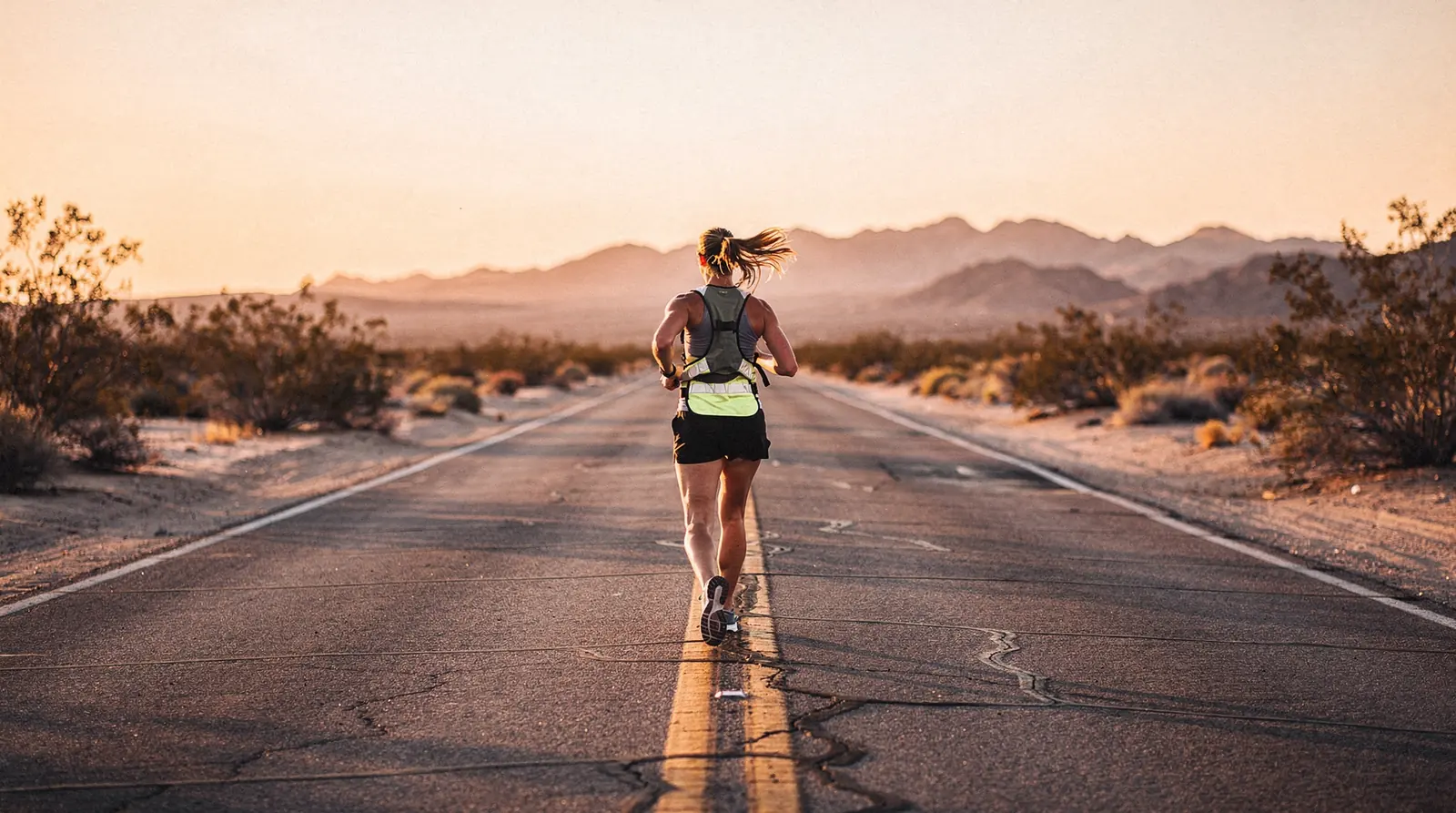
What actually happens between Saturday morning and Sunday morning.
The race begins Saturday on Highway 127, out in open desert with nothing around it. One runner goes. The other nineteen are already moving up the road to their own stages.
Twenty legs, handed off one to the next. Some are flat and fast. Some climb. Nobody gets to pick an easy one, and the team is only ever as quick as its slowest handoff.
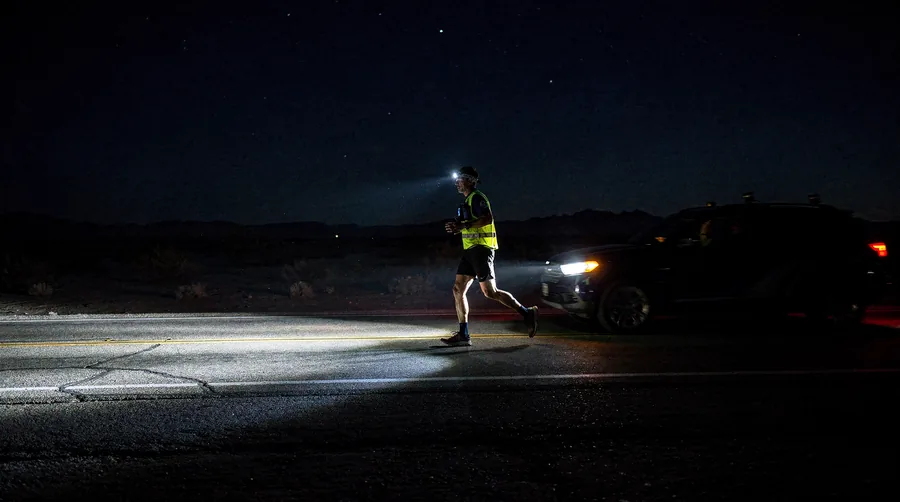
Those runners go out in the middle of the night, in the cold, lit by their own headlamps and the headlights of the vehicle behind them. It is a small share of the twenty legs and the part everybody remembers.
Follow vehicles move with every runner. Drivers, a pace car, a medic, people working exchange points and radios. The relay is not carried by the twenty on the road; it is carried by everyone.
Early Sunday morning, the last stages come in along Highway 160 and end at the Rio. Everyone who has been awake for thirty hours stands there anyway, because that is the whole point.
Baker, California to Las Vegas, Nevada. Two lanes of desert, afternoon through the night and into Sunday morning.
If someone you love is running or crewing this race, here is what the weekend looks like from where you will be standing.
The team arrives in Las Vegas, checks in at the Rio and goes to the race briefing. Dinner together that night, before anyone has to be sensible.
The race starts in the morning out past Baker and does not stop. Your runner may be on the road at any hour, including the middle of the night.
The last stages come into Las Vegas in the morning. The awards ceremony is that evening at the Rio.
The finish is the place to be. The course itself runs through open desert with restricted access — we will send families specific guidance closer to the race.
Tell us early. It helps us plan, and it means somebody is looking out for you that weekend instead of you finding your own way around.
You are our guests, not our audience. You will be invited to meet your runner, and to our events here at home whether or not Las Vegas is possible.
Between 3.2 and 10.7 miles, depending on the stage. Twenty runners cover about 120 miles between them, handing off one to the next the whole way.
No. Our roster has people who have run Baker to Vegas and people for whom this is entirely new, and they train together. The stages range from 3.2 to 10.7 miles, so there is a place for a range of experience and pace.
Runners and crew from across Douglas County. For one weekend and 120 miles they are one team.
Each runner on the team carries the name of a fallen Colorado officer, on the shirt they run in and on the stage they run. Names are carried with the family's permission, arranged through the officer's own agency, and each family decides how the name is written.
Travel, lodging, vehicles and gear — the cost of getting thirty-odd people to the Mojave and home again. Donations are processed by Beyond the Badge, a registered 501(c)(3).
Yes, and it helps just as much. Gear for our runners, or an item for the silent auction. Both come straight off what we would otherwise have to raise.
Our runners and crew come from across Douglas County and we run with the support of the people we work for, but this site is run by the team. Nothing here is an official statement of Douglas County.